
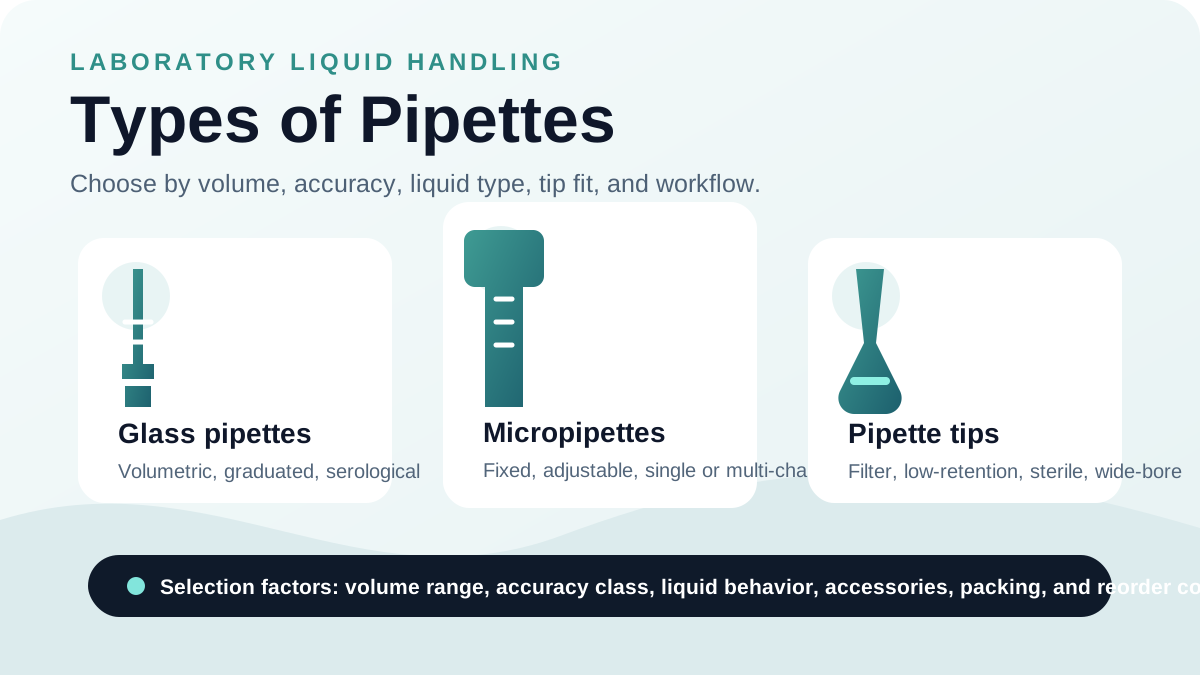
The main types of pipettes used in laboratories include volumetric pipettes, graduated pipettes, serological pipettes, Pasteur pipettes, transfer pipettes, micropipettes, multichannel pipettes, and positive displacement pipettes. They all move liquid, but they do not solve the same job.
For procurement, the best pipette is not simply the most accurate or most expensive option. It is the pipette that matches the required volume, tolerance, liquid type, operator workflow, accessories, and reorder plan.
Quick answer: which pipette type should you choose?
Choose a volumetric pipette for one accurate fixed volume, a graduated or serological pipette for measured variable volumes, a Pasteur or transfer pipette for non-critical transfer, and a micropipette for small measured volumes with disposable tips. For viscous, volatile, hot, cold, or difficult liquids, check whether a positive displacement pipette is more suitable than a standard air displacement micropipette.
| Pipette type | Best use | Accuracy role | Buyer note |
|---|---|---|---|
| Volumetric pipette | One fixed volume | High accuracy for fixed-volume transfer | Confirm volume, class, TD/EX marking, and ISO standard |
| Graduated pipette | Several marked volumes | Flexible measured transfer | Check graduation type, capacity, tolerance, and readability |
| Serological pipette | Measured transfer with a filler or controller | Flexible transfer in biology and general labs | Confirm pump or controller compatibility |
| Pasteur pipette | Drops and small non-exact transfers | Not for accurate measurement | Useful for routine transfer, not calibration work |
| Transfer pipette | Disposable rough transfer | Low accuracy | Common where speed and low cost matter |
| Air displacement micropipette | Small measured volumes | Accurate with correct tip and technique | Good for many aqueous liquids |
| Positive displacement pipette | Difficult liquids | Better for viscous, volatile, hot, or cold liquids | Uses piston-style capillary tips |
| Multichannel pipette | Plate work and repeated transfers | Faster repeat dispensing | Match channel count to plates and reservoirs |
| Pipette tips | Disposable interface for micropipettes | Affects repeatability and leakage | Must fit pipette model and volume range |
What is a laboratory pipette?
A laboratory pipette is a liquid-handling tool used to transfer or measure liquid volumes. Some pipettes are simple glass tubes with calibration marks. Others are piston-operated instruments that use disposable tips. A pipette may be used for analytical chemistry, biology, quality control, teaching labs, reagent preparation, sample transfer, and microplate work.
The word “pipette” is broad. A glass volumetric pipette, a plastic serological pipette, and an adjustable micropipette are all pipettes, but they are not interchangeable. When a purchase request says only “pipette,” procurement should ask for type, volume, class, material, and application before quoting.
How are pipettes classified?
Pipettes are usually classified by measurement role, working mechanism, volume setting, and material.
| Classification | Main options | What it means for buyers |
|---|---|---|
| Measurement role | Volumetric, graduated, serological, Pasteur, transfer | Defines whether the pipette is for fixed accurate volume, variable measured volume, or rough transfer |
| Working mechanism | Air displacement, positive displacement | Defines how the piston and sample interact |
| Volume setting | Fixed volume, adjustable volume | Defines whether one set volume or a range is used |
| Operation | Manual, electronic, controller-assisted | Defines operator workload, speed, and repeatability |
| Material | Glass, plastic, disposable tip system | Defines chemical resistance, sterility, cost, and packing needs |
| Accuracy class | Class A, Class B, general use | Defines tolerance expectations for volumetric glassware |
This classification matters because buyers often mix unrelated items into one quote request. A volumetric Class A glass pipette and a multichannel micropipette belong to different purchasing lines.
Volumetric pipettes
A volumetric pipette is designed to deliver one fixed volume. It usually has a bulb in the middle and one calibration mark. Labs use it when the same accurate volume is transferred repeatedly.
For example, an analytical lab may use a volumetric pipette to transfer a fixed volume into a volumetric flask during standard solution preparation. The pipette, user technique, cleanliness, and calibration all affect the result.
When buying volumetric pipettes, confirm:
- Volume, such as 1 ml, 5 ml, 10 ml, 25 ml, 50 ml, or 100 ml
- Class A or Class B tolerance requirement
- One-mark or two-mark style
- TD / EX marking, meaning calibrated to deliver
- Relevant standard, such as ISO 648 for volumetric pipettes
- Graduation color, readability, and durability
- Packing method for long fragile glass items
Do not buy a mixed pipette set when the method asks for a specific class, volume, or tolerance.
Graduated and Mohr pipettes
A graduated pipette has multiple marks along the tube. It can deliver different measured volumes within its scale. A Mohr pipette is one common graduated style, usually not intended to be drained to the tip unless specified.
Graduated pipettes are useful in teaching labs, routine preparation, and workflows where several measured volumes are needed. They are more flexible than volumetric pipettes, but they are not always the best choice for the highest fixed-volume accuracy.
When ordering graduated pipettes, check:
- Total capacity and subdivision
- Class A or Class B requirement
- Graduation direction and zero position
- Whether the pipette is TD / EX or TC / IN
- Complete or partial delivery style
- Color coding and marking durability
- ISO 835 or other relevant specification when required
If the same exact volume is used repeatedly in analytical work, a volumetric pipette may be the better choice.
Serological pipettes
Serological pipettes are commonly used with pipette fillers, pumps, or controllers. They are often used in biology labs, cell culture work, reagent transfer, and general liquid handling.
They usually cover larger volumes than micropipettes and are useful when users need controlled transfer without mouth pipetting. Buyers should confirm volume, sterility, packaging, graduation style, plug requirement, and controller compatibility.
For B2B orders, separate sterile plastic serological pipettes from reusable glass measuring pipettes. They may look similar in a product list, but their packing, shelf life, and use case are different.
Pasteur, transfer, and disposable pipettes
Pasteur and transfer pipettes are used when exact volume is not the main concern. They are useful for drops, rough sample transfer, and quick bench work.
Glass Pasteur pipettes may be used with bulbs. Plastic transfer pipettes are common where convenience, speed, and low cost matter. These items should not replace calibrated pipettes in analytical work.
A simple rule works well: if the method needs a measured volume, use calibrated measuring equipment. If the method only needs a small non-critical transfer, a Pasteur or transfer pipette may fit.
Air displacement vs positive displacement pipettes
Many micropipettes are air displacement pipettes. In this design, an air cushion sits between the piston and the liquid in the tip. It is a practical option for many aqueous samples, especially when the correct tip and technique are used.
A positive displacement pipette works differently. The piston is closer to the sample and is usually part of the capillary or special tip system. This reduces the effect of the air cushion.
| Mechanism | Best fit | Watch-outs |
|---|---|---|
| Air displacement pipette | General aqueous liquid handling | Accuracy depends on tip fit, technique, temperature, and liquid properties |
| Positive displacement pipette | Viscous, volatile, foaming, hot, cold, or high-density liquids | Tips are more specialized and usually cost more |
For most routine lab work, air displacement micropipettes are common. For difficult liquids, positive displacement may provide better repeatability and less sample loss.
Fixed-volume vs adjustable-volume pipettes
Fixed-volume pipettes are set to one volume. They can be a good choice when the same volume is used many times and method control is strict.
Adjustable-volume pipettes cover a volume range. They are more flexible, so many labs choose them for general use. The tradeoff is that performance can vary across the range, and users must avoid accidental volume changes during work.
For procurement, do not only ask “fixed or adjustable.” Also ask for the working volume range. A pipette should not be forced to operate at the edge of its practical range if accuracy matters.
Manual, electronic, and multichannel pipettes
Manual pipettes are common, affordable, and suitable for many labs. Electronic pipettes can reduce operator variation and repetitive strain in high-throughput work. Multichannel pipettes transfer several samples at once and are common in plate-based workflows.
For microplate work, channel count matters:
| Format | Typical use |
|---|---|
| Single-channel pipette | General single-sample work |
| 8-channel pipette | Columns of 96-well plates |
| 12-channel pipette | Rows of 96-well plates |
| Multichannel adjustable spacing pipette | Transfers between different labware formats |
If your lab handles many plates per day, multichannel or electronic options may save more time than buying more single-channel pipettes.
Micropipettes and pipette tips
Micropipettes are piston-operated tools used for small measured volumes. They work with disposable pipette tips, and the tip must match the pipette model, volume range, and application.
Pipette tips are not a minor accessory. A poor fit can affect delivery, leakage, and repeatability. For filtered tips, low-retention tips, sterile tips, wide-bore tips, or bulk tips, confirm the lab’s application before ordering.
For viscous samples, low-retention or wide-bore tips may help. For aerosol-sensitive work, filtered tips may be required. For routine teaching labs, bulk non-filtered tips may be enough.
Micropipettes also need calibration and maintenance. Do not assume a new pipette will stay accurate forever under heavy use.
How to use pipettes more reliably
Pipette choice is only part of the result. Technique also matters. A good purchasing list should consider whether users need accessories, training, calibration, or replacement tips.
Useful practice checks include:
- Choose the smallest pipette that comfortably covers the required volume.
- Use tips that fit the pipette body and volume range.
- Let pipette, liquid, and tips reach the same room temperature when accuracy matters.
- Pre-wet the tip before accurate transfer.
- Keep the pipette close to vertical during aspiration.
- Avoid immersing the tip too deeply.
- Aspirate and dispense slowly for viscous or foaming liquids.
- Use reverse pipetting when the sample is difficult to dispense cleanly.
- Store pipettes upright and keep glass pipettes protected from breakage.
- Schedule calibration for piston pipettes used in controlled methods.
These details are especially important for distributors because a customer complaint may come from poor tip fit, packing damage, or missing accessories rather than the pipette itself.
How to choose pipettes for a lab set
Match the pipette to the job:
- For fixed-volume analytical transfer, choose volumetric pipettes.
- For teaching labs and variable measured transfer, choose graduated pipettes.
- For cell culture or plate work, check serological pipettes, controllers, micropipettes, and tips.
- For quick non-measured transfer, use Pasteur or transfer pipettes.
- For viscous or volatile liquids, consider positive displacement pipettes or special tips.
- For titration, use a burette, not a pipette.
A school starter set may need glass pipettes, bulbs, graduated cylinders, burettes, and volumetric flasks. A research lab may need calibrated micropipettes, filtered tips, and glass volumetric pipettes. A biology lab may need serological pipettes, pipette controllers, sterile tips, and waste containers.
Buying checks for pipettes
Before placing a B2B order, confirm:
- Pipette type and volume range
- Class and tolerance when needed
- TD / EX or TC / IN marking
- Glass, plastic, or piston pipette material
- Sterile, non-sterile, filtered, low-retention, or wide-bore tip needs
- Pipette pump, filler, or controller compatibility
- Calibration records or service needs for piston pipettes
- Product codes for repeat orders
- Packing method for glass pipettes
- OEM label, barcode, or carton mark needs
For distributor orders, separate glass pipettes, micropipettes, tips, and accessories in the quotation. They serve different workflows and should not be bundled under one vague item name.
Building a balanced liquid-handling set
A lab often needs more than one pipette type. A teaching lab may need glass graduated pipettes, bulbs, volumetric pipettes, burettes, and measuring cylinders. A biology lab may need serological pipettes, pipette controllers, micropipettes, sterile tips, and waste containers. A QA lab may need calibrated piston pipettes and controlled tip lots.
The buying list should follow the workflow. If users prepare standard solutions, include volumetric flasks and volumetric pipettes. If users run titration, include burettes and Erlenmeyer flasks. If users work with microplates, include multichannel pipettes and compatible tips.
This approach prevents a common problem: buying pipettes without the supporting accessories. Pipettes, bulbs, pumps, controllers, tips, racks, and calibration records all affect daily use.
Consumables and reorder control
Pipette tips should be managed as controlled consumables when measurement quality matters. Tip volume range, filter option, sterility, rack format, and compatibility should be written into the purchasing list.
For glass pipettes, the reorder list should include volume, class, marking style, package quantity, and breakage protection. For micropipettes, it should include model, serial tracking, tip type, calibration status, and service plan. Keeping these details together helps procurement avoid mixing unrelated items under one broad pipette line.
How to compare pipette quotes
Pipette quotes should separate glass pipettes, piston pipettes, tips, and accessories. A volumetric glass pipette is not the same product as a micropipette. A pipette tip is not a replacement for the pipette body. Keep each product type on its own line.
For glass pipettes, compare volume, class, tolerance, marking style, TD/EX marking, standard, and packing. For micropipettes, compare volume range, channel count, compatible tips, calibration record, service path, and serial tracking. For tips, compare volume range, filter option, sterility, rack or bulk pack, and compatibility.
Buyers should also ask how fragile glass pipettes will be packed. Long thin glass items need inner support, and mixed cartons should not crush them.
Sample quote request for this topic
Use a format like this: pipette type, volume or volume range, class or tolerance if needed, TD/EX or TC/IN marking, glass or plastic, sterile or non-sterile if relevant, tip compatibility, quantity, destination country, packing, barcode label, and OEM packaging requirement.
If the order is for a full lab set, include related liquid-handling items: bulbs, pumps, pipette controllers, tips, burettes, volumetric flasks, and measuring cylinders.
Internal links for buyers
Review the pipettes category and compare related burettes and measuring cylinders. For broader purchasing, use the full products catalog.
For a quote, send pipette type, volume, class or tolerance needs, quantity, destination country, and packing requirements through the contact page.
FAQ
What are the common types of pipettes used in laboratories?
Common types include volumetric, graduated, serological, Pasteur, transfer, air displacement micropipettes, positive displacement pipettes, multichannel pipettes, and matching pipette tips.
Which pipette is most accurate?
For one fixed liquid volume, a Class A volumetric pipette is often used for high-accuracy transfer. For small-volume piston pipetting, the micropipette, tip fit, liquid type, user technique, and calibration all matter.
What is the difference between air displacement and positive displacement pipettes?
An air displacement pipette uses an air cushion between the piston and the liquid. A positive displacement pipette places the piston closer to the sample through a special tip or capillary system, which can help with viscous, volatile, hot, or cold liquids.
Are Class A pipettes better than Class B pipettes?
Class A pipettes have tighter tolerances and are used when higher accuracy is required. Class B pipettes have wider tolerances and may fit routine or teaching use where strict analytical accuracy is not needed.
Are pipette tips universal?
Not always. Tips must fit the pipette brand, volume range, and application. Confirm compatibility before bulk ordering.
What should be included in a pipette quote request?
Include pipette type, volume, class or tolerance, TD/EX or TC/IN marking, material, tip needs, quantity, destination country, and packing details.