
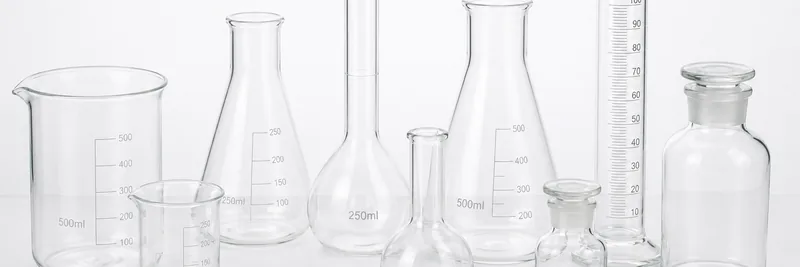
Borosilicate glass is a low-expansion glass used in many laboratory beakers, flasks, bottles, condensers, tubes, and distillation parts. Labs choose it because it handles routine heating, cooling, and chemical contact better than common soda-lime glass when the product is made for that use.
That does not mean every borosilicate glass item is safe for every chemical, every heat source, or every pressure condition. The exact product design still matters. Wall thickness, shape, joint size, stopper type, graduation, and manufacturer instructions all affect how the glassware should be used.
For buyers, the practical question is simple: are you sourcing everyday display glass, or are you sourcing labware that must survive repeated bench work? If the answer is lab work, borosilicate glass should usually be your starting point.
Quick answer: what is borosilicate glass?
Borosilicate glass is glass made with silica and boron-containing ingredients, giving it lower thermal expansion than ordinary soda-lime glass. Lower expansion helps the glass handle temperature changes with less stress.
In laboratory buying, you will often see the term borosilicate 3.3. This points to a common low-expansion borosilicate glass type used for many labware products. It is widely used for beakers, Erlenmeyer flasks, volumetric flasks, reagent bottles, condensers, distillation glassware, and other bench items.
A good short rule is this:
| If you need… | Choose… | Why |
|---|---|---|
| Routine lab heating and chemical handling | Borosilicate labware | Better fit for bench use than soda-lime glass |
| Low-cost containers for light-duty storage | Soda-lime glass or plastic | Lower cost when lab-grade resistance is not needed |
| Accurate volume preparation | Calibrated volumetric glassware | Material alone does not make a vessel accurate |
| Vacuum or pressure work | Product-rated apparatus only | Shape and design matter more than material name alone |
Why borosilicate glass works well in labs
The main value of borosilicate glass is controlled expansion. When glass heats up, different areas may expand at different speeds. If that stress gets too high, the item can crack. Borosilicate glass helps reduce that risk in normal lab use because it expands less than common soda-lime glass.
It also has good resistance to many chemicals used in routine laboratory work. That is why you see it across chemistry labs, school labs, quality-control labs, and industrial testing rooms. It can be made into simple vessels like beakers, or more shaped parts like condensers and adapters.
Still, it is not unbreakable. Scratches, chips, sharp temperature changes, poor clamping, and wrong equipment choices can all shorten the life of glassware. Treat borosilicate as a strong material choice, not as permission to ignore the product instructions.
Borosilicate glass vs soda-lime glass
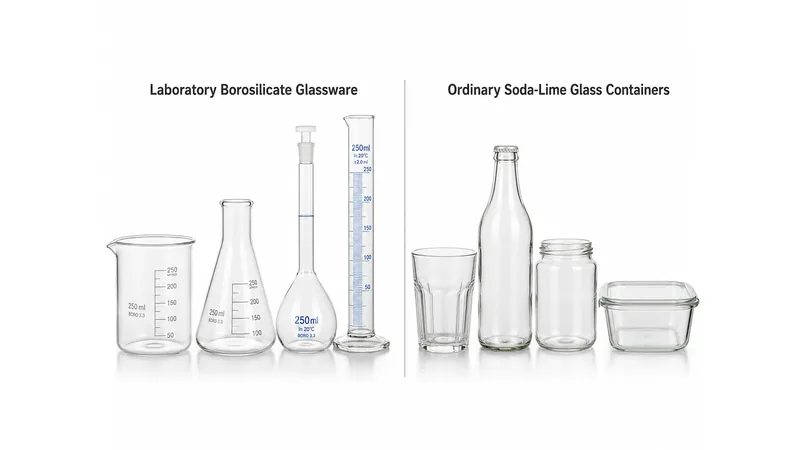
Soda-lime glass is the common glass used in many bottles, jars, and household products. It can be clear, useful, and low cost. It is not the same as lab-grade borosilicate glass.
| Feature | Borosilicate glass | Soda-lime glass |
|---|---|---|
| Thermal expansion | Lower | Higher |
| Thermal shock resistance | Better for many lab uses | Weaker under fast temperature changes |
| Routine lab chemical contact | Often preferred | More limited for lab use |
| Cost | Usually higher | Usually lower |
| Common use | Labware, process glass, heat-resistant vessels | General containers and display items |
For procurement teams, the choice depends on use. If the item only stores dry samples at room temperature, soda-lime may be enough. If the item is part of heating, cooling, solution prep, distillation, or chemical handling, borosilicate is usually the safer buying path.
Common borosilicate glassware products
Most core laboratory glassware categories can be made from borosilicate glass. The buyer should still check the product page, because not every item in a catalog uses the same material or tolerance.
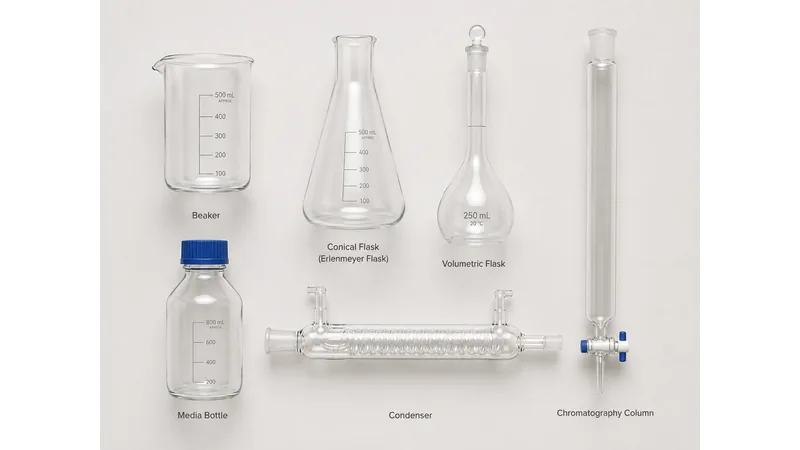
Common product groups include:
- Beakers for mixing, heating, transfer, and rough volume checks
- Erlenmeyer flasks for swirling, titration receiving, solution mixing, and storage with stoppers
- Volumetric flasks for preparing solutions to a marked volume
- Reagent and media bottles for storage and sample handling
- Condensers for reflux and distillation workflows
- Distillation receivers, heads, adapters, and boiling flasks
- Chromatography columns and reservoirs
- Burettes, pipettes, and measuring cylinders when made to the required class and tolerance
The material matters, but the product role matters too. A borosilicate beaker is not a volumetric flask. A graduated cylinder gives better volume reading than a beaker, but it still does not replace a calibrated volumetric flask or pipette when analytical accuracy is needed.
For common bench vessels, compare laboratory beakers by capacity, form, graduation style, and packing before adding them to a borosilicate glassware list. A routine beaker line such as Low Form Griffin Beaker Wholesale is a practical starting point for mixed-capacity bench sets. If beakers are the first line item, the beaker guide can help buyers separate low-form, tall-form, and rough-graduation needs.
For fixed-volume solution prep, keep Volumetric Flasks separate from general flasks and beakers in the quote. A Liebig Condenser is a useful example when the request includes shaped borosilicate parts for reflux or distillation, and Chromatography Column Heavy Wall Design can support formed glass products used beyond simple containers. For jointed apparatus and receivers, the distillation apparatus guide gives buyers a more detailed compatibility checklist.
Buying checks before you order borosilicate glassware
When you request a quote, do more than ask for borosilicate glass. Give enough detail for the supplier to match the right item.
Start with these checks:
- Confirm the glass type shown on the product page or specification sheet.
- Confirm the capacity, size, and shape.
- For measuring items, check class, tolerance, graduation, and calibration marks.
- For jointed apparatus, confirm joint size, gender, and connection layout.
- For capped bottles, confirm cap material, liner, mouth type, and thread size.
- For export orders, confirm packing method, carton mark, barcode, and OEM label needs.
- For repeat orders, keep the product code and capacity list in your purchasing file.
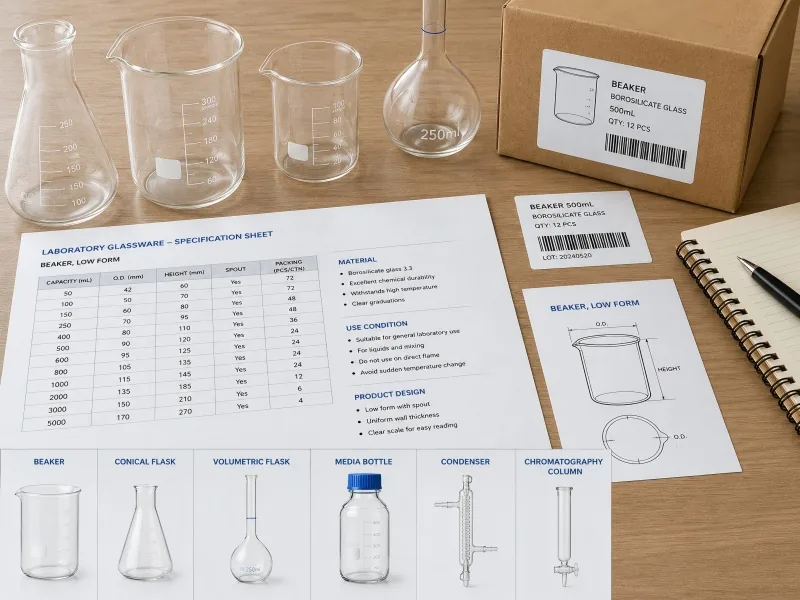
This is where a B2B supplier can help. Lab Glassware Suppliers works with product lists, capacity requirements, OEM label needs, carton planning, and export packing details. That is more useful for repeat purchasing than a vague one-line request for glassware.
Procurement scenarios for borosilicate glass
A school distributor may care most about balanced capacity sets, durable packing, and simple reorder codes. A research lab may care more about exact glass type, compatibility with existing joints, and replacement parts for high-use items. An industrial lab may ask for the same items across several locations, so product-code stability matters.
This is why one borosilicate glassware quote can look very different from another. A 250 mL beaker, a GL45 media bottle, and a distillation adapter may all use borosilicate glass, but they do not solve the same buying problem. Each line item should list the product type, capacity, material, pack size, and any class or tolerance note.
For export orders, packing should be part of the buying conversation from the start. Fragile glassware needs carton planning, inner protection, label placement, and clear capacity markings. If the order will be sold under a distributor label, add barcode, carton mark, and OEM label needs before the supplier quotes.
Specification terms buyers should know
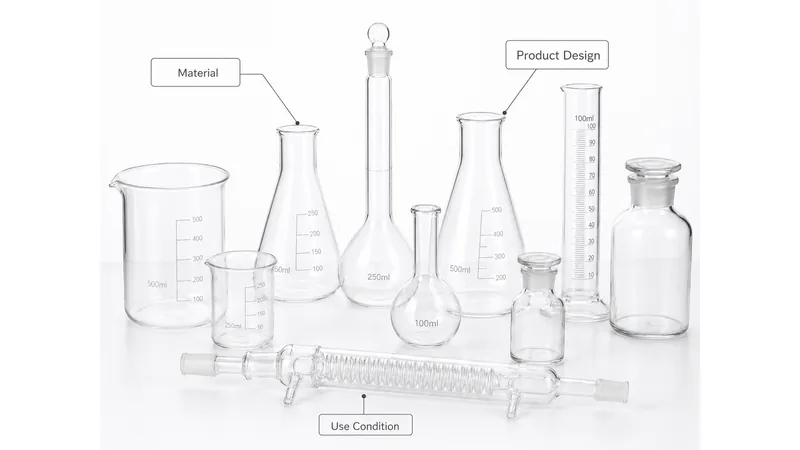
Three terms come up often: material, tolerance, and use condition. Material tells you what the glass is made from. Tolerance tells you how close a measuring item should be to its stated volume. Use condition tells you whether the product is meant for heating, storage, transfer, vacuum, or measurement.
These terms should not be mixed together. Borosilicate glass is a material. Class A is a tolerance category for selected volumetric items. Vacuum suitability is a design and product-rating question. When a request combines them clearly, the supplier can quote the right item faster.
Measuring Cylinders Hexagonal Base can be linked when explaining that measurement roles depend on design and markings, not material alone. When the request includes fixed-volume solution prep, use the volumetric flask guide instead of treating all glassware as equivalent.
How to compare borosilicate glassware quotes
When two suppliers quote borosilicate glassware, compare more than the unit price. Check whether both quotes use the same product type, capacity, glass material, wall style, tolerance, packing method, and label plan. A lower unit price can become expensive if the carton breaks, the markings fade, or the product code changes on the next order.
Ask for the specification table before confirming a large order. For measuring glassware, look for class and tolerance. For jointed parts, look for joint size and connection layout. For bottles, check cap material, thread type, liner, and closure fit. For beakers and flasks, check capacity range and graduation style.
If your order includes many product types, group them by category. Put beakers, flasks, bottles, condensers, and measuring items in separate sections. That helps the supplier quote accurately and helps your receiving team check cartons against the purchase order.
Sample quote request for this topic
Here is a practical format: borosilicate laboratory glassware, product list attached, capacities by line item, quantity by capacity, destination country, export carton requirements, OEM label if needed, barcode label if needed, and preferred shipping mark.
If the order is for repeat resale, add one more request: keep product codes stable across future quotations. That makes catalog updates, warehouse labels, and reorder planning easier.
Internal links for buyers
If you are building a product list, start with the main laboratory glassware catalog. For common borosilicate items, compare beakers, flasks, and distillation glassware.
When you are ready to request a quote, send the capacity, quantity, destination country, and packing needs through the contact page.
FAQ
Is borosilicate glass the same as Pyrex?
Not always. Pyrex is a brand name used for certain glass products. Borosilicate glass is a material type. For procurement, check the actual material specification instead of relying on a brand-style word.
Is borosilicate glass safe for direct flame?
Do not assume that. Some labware may be heated under controlled lab conditions, but direct flame use depends on the item, wall thickness, shape, and instructions. Use the product guidance and your lab SOP.
Does borosilicate glass make volume measurements accurate?
No. Accuracy comes from the glassware design, calibration, class, and reading technique. A borosilicate beaker still gives only rough volume guidance. Use volumetric flasks, pipettes, burettes, or measuring cylinders when the volume matters.
What should I send when asking for a quote?
Send product names or links, capacities, quantities, destination country, and packing needs. Add OEM label, barcode, or carton mark requirements if you need distributor-ready packaging.